
Construction Site Security: Portable CCTV or Access Control?
If you run an active construction site, the security envelope begins as a fenced empty lot and changes shape every fortnight. Slab, frame, lock-up, fitout: each phase brings a different perimeter, a different value at risk, and a different cast of trades. For project managers, site supervisors, and builders running multiple active sites across Brisbane and the Gold Coast, standard “alarm and CCTV for businesses” advice does not quite fit, because a job site rarely has permanent power, a fixed network, or a stable list of who is allowed through the gate. By the end you will know what a modern integrated site setup looks like, where a fence-and-trailer-camera setup runs out, and how to scope CCTV, access, alarms, and monitoring on a site that is still being built. Already know what you need? See our site security solutions page.
What a modern integrated construction site security setup actually is
A modern integrated construction site security setup is four things working on a temporary site: portable CCTV on the perimeter and high-value compound, access control at the gate and the donga office, a monitored alarm behind the site office, and a back-to-base path someone is actually paying attention to. The design does not need permanent building power, NBN, or permanent building cabling. The CCTV usually runs off solar with a 4G uplink. The access reader runs from the same battery system or the donga compound’s generator. On platforms where cameras, alarm, and access events share a ruleset, and where the induction platform exposes status to the access layer, a gate event, camera clip, alarm trigger, and supported induction-status check can sit in one incident record. The gate, perimeter, and compound are not watched continuously, and the site is unmanned overnight, so the platform does the work staff would otherwise do live.
Where a fence-padlock-trailer-cam setup falls short
A site with a perimeter fence, a chained gate, a couple of trailer-mounted cameras, and an active monitoring contract is not doing anything wrong. For a short residential build with a small materials footprint, that is often enough.
Once value at risk grows or the perimeter stretches past what one trailer can see, the gaps show. Two cameras cover a slab; they cannot cover a 1 km civil perimeter, the donga compound, the laydown area, and the plant yard at once. A padlocked gate does not tell you whether the right subbie turned up, whether their induction is current, or whether the delivery driver who said they were leaving actually left. When the site office alarm trips at 2am, you get a phone call with an event code and no clip; the patrol drives out blind or the alert is treated as routine. The temporary site security plan that worked at slab is not the one you want at lock-up.
Portable CCTV towers vs fixed cameras
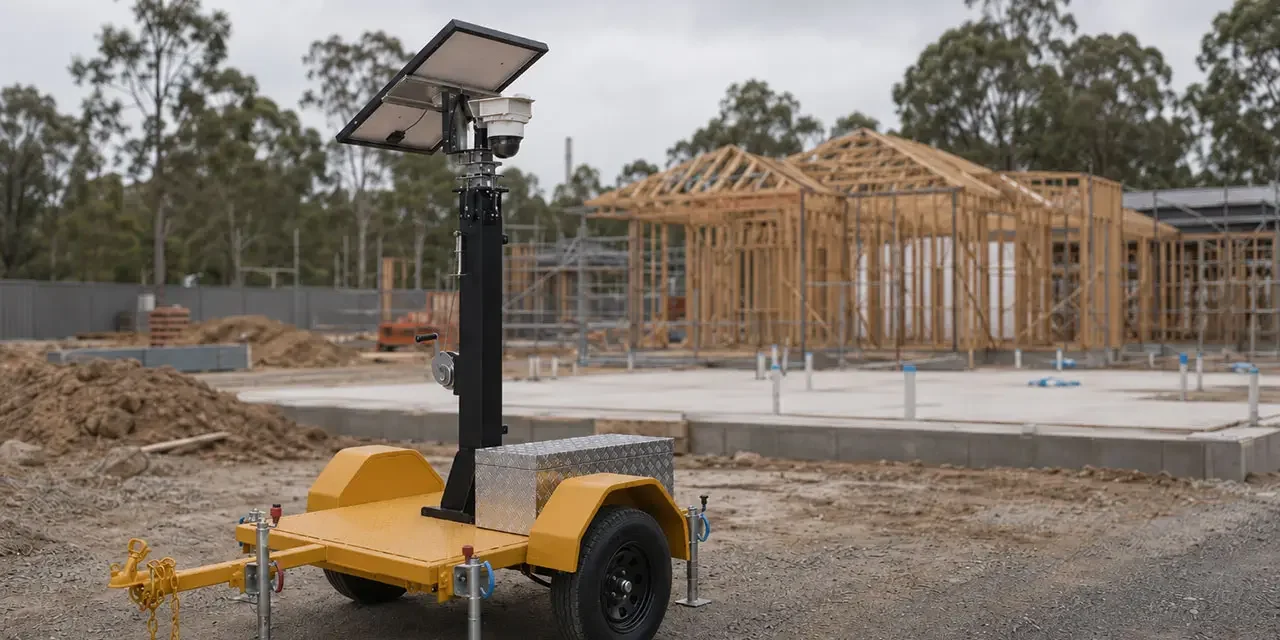
Portable CCTV towers detect, record, and alert on activity; they do not replace gate access, alarms, or an agreed response path. They are the workhorse of temporary site security: a solar trailer with a mast-mounted PTZ, onboard recording, and a 4G uplink can land on a fenced lot before mobilisation and start providing coverage straight away. Towers suit civil sites without permanent power, residential sites at slab and frame phase, and any compound that will move once the build progresses past it.
Where analytics and monitored speakers are part of the tower package, person and vehicle alerts plus voice-down can give the responder a chance to intervene before dispatch, but the result still depends on coverage, monitoring rules, and the agreed response path.
The trade-offs are real. Solar performance depends on panel orientation, weather, and battery condition; 4G coverage is site-specific; image quality at distance varies by camera and mast height. Fixed cameras come in once site power lands or the building is closed enough to mount a camera on a structure that will still be there through the next phase. On long civil projects without NBN, 4G CCTV on construction sites usually runs as primary 4G with a second-carrier 4G failover rather than IP plus cellular. Most sites end up running a mix.
Subcontractor access: gate readers tied to site induction
The biggest non-theft access problem on a construction site is “who is on site right now”. A padlock with a shared key cannot answer it, and a paper sign-in sheet at the donga stops getting filled in quickly. Construction site access control on the gate, with a card or PIN tied to a specific subbie and their company, can.
The credential should reflect site induction status. Uninducted subbies do not get a PIN. Time-bound passes cover delivery drivers, plant operators on hire, and one-day trades; the pass expires when the work is done and entry is logged against the right name. Where the induction software exposes status and the access platform supports that mapping, a tap at the gate can flag a missing or non-current site induction or expired white card before entry, provided those records are kept current in the induction platform. On the perimeter a card or PIN is usually the right answer, because gloves, dust, and weather are not friends of fingerprint readers.
Want a second opinion on your current site security plan? Talk to a Metwide engineer.
After-hours monitoring, verified alerts, and equipment theft
The construction site alarm is a small piece of hardware doing a specific job: it makes noise, it signals, and on integrated setups it pulls in context. On platforms where the alarm, CCTV, and access events share a ruleset, a trigger on the donga at 11pm can land as a verified alert with the nearest camera clip and the gate log of who tapped through in the last hour. Signalling on a site without NBN is usually dual-path 4G with a second-carrier 4G failover rather than IP plus cellular; the dual path is designed to keep signalling when one carrier drops, provided the failover is configured, supervised, and in coverage, and local alarm functions should keep running during an outage. Our post on modern monitored alarm systems covers the alarm side in more depth.
High-value theft targets shift by phase: copper, fuel bowsers, hand tools, and generators at slab and frame; power tools at fitout; white goods and finishes near completion; plant overnight at any phase. The defence chain is detection, verified alert, response, and a recorded incident; no platform stops theft outright. An integrated setup shortens the time between something happening and someone with context deciding what to do, and produces the back-to-base monitoring record an insurer may ask for after the fact.
Multi-site visibility, insurance, and the privacy line
Builders running 4 to 10 active sites have an admin problem standalone systems do not solve. One dashboard across every active site, with per-site rules and delegated admin, plus per-site reporting for the commercial team and the insurer, is where the integration layer earns its keep. Our post on access control for multi-site businesses covers the dashboard side.
The practical difference is that Metwide scopes the tower, gate reader, alarm signalling, cabling, 4G path, and hand-back plan together, instead of leaving the builder to join a tower hire vendor, electrician, locksmith, and IT provider after install.
Insurance sits alongside this. Builder’s all-risk and contract works policies may ask for evidence around perimeter, monitored alarm systems with a recorded back-to-base path, retained CCTV, and theft-claim documentation. Specifics vary by policy and builder; check with your broker before hardware is ordered. Where the Privacy Act applies, worker CCTV footage is sensitive in different ways from customer footage, and induction records may include personal information; set retention, access, export, and deletion rules with your provider regardless. At practical completion the security envelope changes hands: temporary kit decommissions, and a documented record of the build period stays with the builder for any post-hand-back claim.
Standalone fence-cam vs integrated construction site security: side-by-side
| Capability | Standalone fence and trailer-cam setup | Integrated construction site platform |
|---|---|---|
| Perimeter coverage on a moving site | Two trailer cams, manually moved each phase | Solar towers and PTZs in one dashboard, repositioned as the build moves |
| Gate access | Padlock with a shared key | Card or PIN reader tied to a specific subbie and their company |
| Subcontractor induction at the gate | Paper sign-in or none | Tap can be checked against induction status where the platforms support that mapping |
| After-hours alert | SMS or call with an event code | Notification with camera clip and gate log on integrated setups |
| Signalling on a site without NBN | Single-carrier 4G, often unsupervised | Common on modern systems: dual-carrier 4G with supervised failover |
| Equipment-theft incident record | Camera footage retrieved by hand | Verified alert and access log in one record |
| Reporting for builder, insurer, or head office | Per-site, manual collation | Exportable from one audit trail across active sites |
| Hand-back to permanent security | Disconnect, decommission separately | Temporary kit removed, documented record handed to the next operator |
One-line verdict. A short, low-value, single-phase site with a fence and a trailer-mounted camera is often fine. Once the perimeter is bigger than what one trailer can see, value at risk is climbing through fitout, or you are running more than one or two active sites, the integration layer is where the real gains sit, not a second trailer.
Construction site security for Brisbane and Gold Coast operators
A mid-sized residential builder running 8 active sites between Brisbane and the Gold Coast. Single-dwelling and townhouse projects at every phase. Solar trailers and mast-mounted PTZ on the perimeter at slab and frame, fixed cameras on the donga and around the building once it locks up, and a card reader on the gate at every site. Subbies tap in against their induction record; an out-of-date white card surfaces at the gate rather than at audit. Each supervisor runs their own site from the dashboard, head office sees every job in one view, and the commercial team pulls per-site theft and incident reports without rebuilding them each month.
A civil contractor on a multi-month earthworks project on the Gold Coast. A 1.5 km perimeter, heavy plant overnight, a donga compound near the access road with fuel bowsers and generators on it, and substantial copper exposure once trenching kicks in. Multiple solar towers reposition as work moves down the alignment, with dual-carrier 4G signalling because there is no NBN. The site office alarm reports back-to-base on the same path, and the gate reader covers plant operators on hire and plant-hire drop-offs alongside permanent staff. Verified alerts route to the project manager and the monitoring centre together, so the patrol does not drive to the wrong end of a long site.
A commercial fit-out contractor running short shop fit-outs inside leased shopping-centre tenancies. Centre security covers the common areas, but the fit-out tenancy is the contractor’s exposure. Loading-dock access and after-hours work windows are negotiated with centre management; a temporary card reader on the tenancy door, a portable camera covering the works, and a small monitored alarm on the tools and finishes once they land cover the practical risk through the fit-out window.
How to decide: scope from scratch, extend, or minimal-touch
Most construction sites are scoped fresh per project, so the keep-upgrade-replace framing for a permanent premises does not directly apply. Six questions get most builders most of the way there.
- How long will this site be live? A six-week slab-to-fitout is different from a 14-month civil project; duration shapes hire vs purchase.
- What is the perimeter, and what value sits inside it? A 1 km civil alignment with overnight plant is different from a residential lot with a stack of timber.
- How many subcontractors come and go each week? Higher subbie traffic pushes the case for jobsite surveillance and a gate reader tied to induction over a shared key.
- What do you expect to happen at 2am? A monitored alarm with verified alerts and a defined response path is a different commitment from “the patrol drives past on the way to other sites.”
- What do your insurer and the builder’s all-risk policy require? Confirm clauses on perimeter, monitored alarm, retained CCTV, and incident records before hardware is ordered.
- What happens at hand-back? Plan how the temporary kit decommissions and how the build-period record transitions to the next operator.
The shape falls out: scope from scratch for long or high-value greenfield builds; extend an existing tower or platform when you already run a portfolio dashboard; minimal-touch when a fence-padlock-trailer-cam setup with active monitoring fits.
What drives cost and scope
Three questions shape most projects.
- Site duration. Short sites lean toward hire; long sites earn the case for purchase or longer-term lease, particularly if the equipment can move to the next project.
- Perimeter length and value at risk. A 200 m residential perimeter scopes very differently from a 1 to 2 km civil alignment with overnight plant.
- Integration scope. A read-only feed into the builder’s PM software is one effort; a bidirectional link with the induction platform that updates the gate reader live is another. Confirm what your software exposes before scoping the rest.
What a Metwide site assessment looks like for construction
An engineer from our field team (NSW and QLD security and cabling licences) walks the site, confirms the perimeter and access points, scopes camera positions for each phase, checks 4G signal at the donga and along the perimeter, and notes induction-software and PM-software integration paths. You get back a written plan covering CCTV tower and fixed-camera positions, gate access, alarm and back-to-base, costs per site or per phase, and a hand-back plan for practical completion. From there you decide what to do next, on your timeline.